The Odyssey begins with an invocation. The Lombardo translation reads as follows:
Speak, Memory --
Of the cunning hero,
The wanderer, blown off course time and again
After he plundered Troy's sacred heights. (1.1-4) [1]
The opening line in Greek is ἄνδρα μοι ἔννεπε, μοῦσα,[2] literally, “Sing to me, Muse.” Mnēmosynē is the goddess Memory incarnate (her name is the word for “memory”). She is the mother of the Muses. The Iliad and Odyssey begin with invocations to the “Goddess,” and “Muse” respectively. [3]
The Muses, according to Hesiod, are the children of Memory and Zeus. Their function or role in the Cosmos is to entertain and facilitate memory through choral song and dance. Thus, when Homer invokes a “Muse” (Kalliope, as she is the Muse of epic), he is calling on the goddess to help him entertain and facilitate memory (his own memory and that of his audience). These are precisely the functions of poetry (specifically oral poetry) in Archaic Greece, and we will see a dramatization of this function play out later, in the halls of Odysseus in Book 1 and of Alcinous in Book 8, wherein bards perform lyrical stories that both entertain their audience and contribute to the memory of the heroes and events from the past that they sing about.
Although attributed to Homer and certainly of early Archaic origins, the Odyssey is a decidedly different poem from the Iliad in a few notable ways. The epics span from the acute focus of Achilles’ rage and questions of honor over the course of a handful of weeks in the Iliad, to Odysseus’ ten-year trek to get back home in the Odyssey. The Iliad is widely considered a war poem that offers a look inside family life just once in 24 books; whereas the Odyssey chronicles three generations of a single family to sustain itself and reaffirm its bonds. While we will confront these and other differences between the two epics, one difference we must discuss at the outset is the plot structure of the Odyssey.
First, the plot structure of the Iliad is linear . Events that occur in Book 1 happen chronologically before those of Book 2, and so on down the line to the end in Book 24. Significant portions of the Odyssey are narrated by the hero himself long after the fact – told in flashbacks, if you will. Second, the human activities in the Iliad, apart from brief allusions to the past, take place exclusively at Troy, either in the Greek camp, on the plains of Troy, or within the city itself.[4] The plot of the Odyssey, on the other hand, is nonlinear ( circular ).
Second, the epic is composed of multiple parallel plots that take place at various times and across vast distances. The Odyssey spans ten years of action, from the sack of Troy to Odysseus’ eventual homecoming on Ithaca. However, Book 1 of the Odyssey begins at the chronological end of Odysseus’ travels, in its final year. The majority of Odysseus’ encounters, such as those with Polyphemos, Circe, speaking with shades of dead heroes in the underworld, etc. occurred well before we first meet him on Calypso’s island (seven years earlier, in fact). There are a couple reasons for the nonlinear plot structure, but the most pressing for the Odyssey likely has to do with the second point: its parallel plot structure.
While the Iliad is a sprawling epic loosely strung together around the core of Achilles’ rage and its impact on Greeks and Trojans alike, the various side stories, flashbacks, and extended metaphors all work in service to the rage of Achilles, its effects, or they are relatively short and self-contained. There are no sustained stories weaved throughout the Iliad that threaten to outshine the spotlight on Achilles’ rage. The Odyssey, on the other hand, despite covering nine and a half more years than the Iliad, is laser focused on two plots that dovetail together into one at the end:
However, Odysseus’ struggles occupy the better part of ten years. Penelope’s efforts are only chronicled for a short period of time at the end of those ten years. The real-time chronicling of Telemachus’ activities takes less than a year to complete, that is narrating the short time in which Telemachus reached the age of adulthood and assumed all the responsibilities that such a change in status entailed in the Homeric world. How does one give weight to the struggles of Penelope and Telemachus if their actions only occur in the last 10% of the epic’s timeline? Furthermore, Odysseus spends a year feasting in Circe’s halls and seven more years on Calypso’s island. There is a lot of narrative “down time” to account for in those eight years. Beginning the story with Telemachus and Penelope in the final year of the Odyssey, however, allows the storyteller to selectively pick and choose moments from the prior nine or so years of Odysseus’ life. The poet can maintain a more palatable pace using flashbacks which only need tell of specific, momentous occasions sandwiched throughout Odysseus’ 10 years adventure.
The Odyssey is the first and most prolific of a group of stories referred to as “Returns.” As a part of the Archaic Trojan Cycle of epics, the Odyssey was joined by the Returns in a group of works that combined to tell the story of the Trojan War from its inception to the sack of Troy to the struggles of its heroes to return home on the other side of the Aegean Sea. the Returns narrates the stories of multiple heroes as they struggle to get back home. The Odyssey, as the name implies, is concerned with Odysseus and his family. But the Odyssey was composed before the Returns, and it did summarize some of the adventures that other Greek heroes experienced on their way home from Troy – many of which would be covered in greater detail by poets in later centuries. Telemachus learns about some these struggles by speaking with Nestor, Menelaos, and Helen; while Odysseus interacts with the shades of his mother and Agamemnon, among others, in the underworld.
The first scene of the Odyssey opens on Olympos. In part, this conversation amongst the gods is merely a plot device to situate its audience within the narrative, inform us what has happened and what has become of Odysseus. It also introduces a core lesson or theme that is reiterated throughout the epic: the place of human beings in the cosmos. Let us analyze Zeus’ speech at lines 37-48. It is ostensibly a reply to Athena’s plea on behalf of Odysseus, thus setting in motion the final leg of the hero’s long trek home. But that utilitarian plot device is couched in the god’s characterization of human life:
“Mortals! They are always blaming the gods
For their troubles, when their own witlessness
Causes them more than they were destined for!
Take Aegisthus now. He marries Agamemnon’s
Lawful wife and murders the man on his return
Knowing it meant disaster – because we did warn him,
Sent our messenger, quicksilver Hermes,
To tell him not to kill the man and marry his wife,
Or Agamemnon’s son, Orestes, would pay him back
When he came of age and wanted his inheritance.
Hermes told him all that, but his good advice
Meant nothing to Aegisthus. Now he’s paid in full.”
First, note that the term Homer uses to refer to humans is “mortals”[5] rather than humans, men, mankind, etc. This emphasizes a fundamental feature of humanity in contrast to gods: mortality. Humans are born to die. We are mortals. The gods live forever. They are ageless and immortal.
Second, Zeus asserts that humans suffer because of their witlessness. Human ignorance is a common theme throughout Greek myth, and it is a second defining feature that separates humans from gods: gods are all-knowing while humans live in ignorance. In other words, gods enjoy absolute knowledge, access to absolute truth. Humans, on the other hand, live in a world of empirical knowledge, “truths” that are subjective [6] and liable to change according to changing information and perspective. Think of the gods and humans as narrators in a novel: gods would act as omniscient narrators whereas humans are first person narrators who can only speculate about what happens in places that their characters cannot see or in minds they cannot read.
Attic red-figure kalyx-krater by the Dokimasia Painter (c. 470 BCE). Boston 63.1246.
Aigisthos (Aegisthus), with a sword, has stabbed Agamemnon, who is caught in a net, and Clytemnestra rushes in from the left with a small axe. The daughters of Agamemnon and Clytemnestra, Elektra and Chrysothemis, are probably the other two women, while Cassandra is probably the woman running away.
This heinous murder and violation of xenia on the part of Aegisthus is the scene to which Zeus refers in Book 1 of the Odyssey and will lead to his own murder at the hands of Orestes later. The death of Agamemnon is a popular story in the returns, and it will be referred to at least three times in the Odyssey alone.
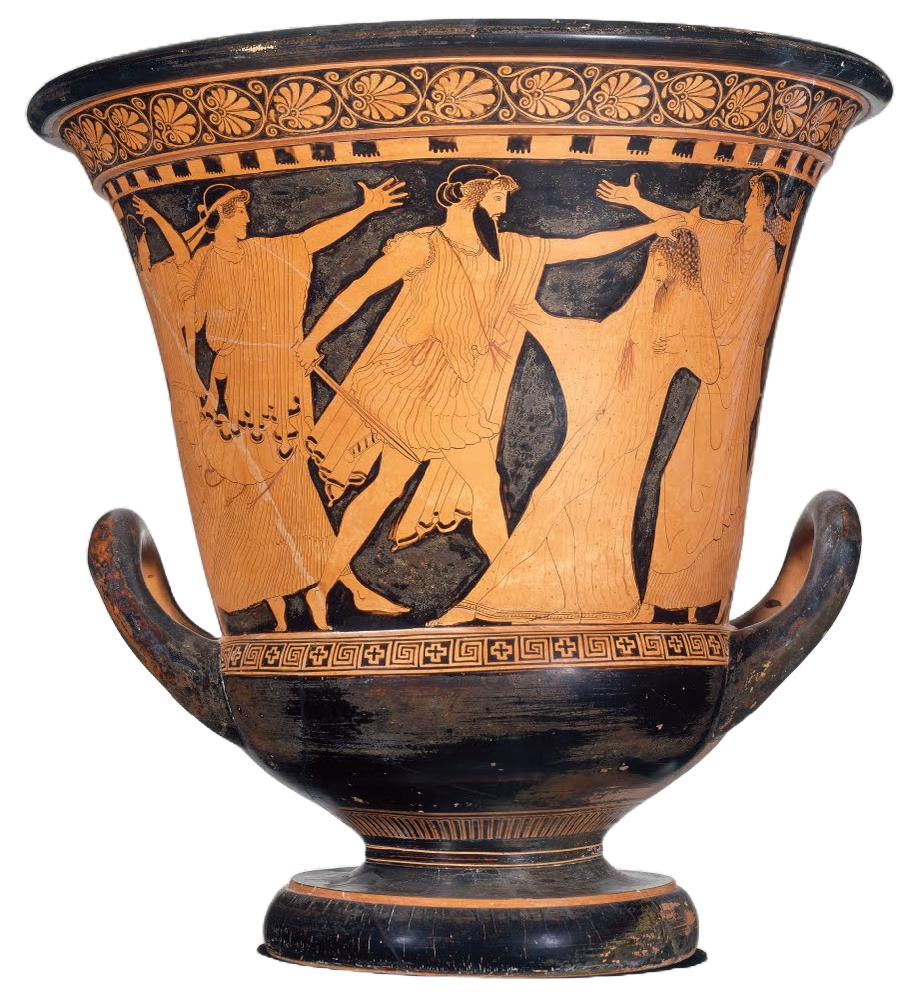
Copyright Boston Museum of Fine Arts. Boston 63.1246.
The MFA's copyrights are weird - everything available for download is supposedly in the Public Domain, but their Terms of Use state that everything on the website is copyrighted. This constitutes Fair Use. However, read their ToU before using this image.
In Greek myth, and this concept remains relatively stable through most world cultures, there are three defining features of humans in relationship to gods:
These three differences will be considered fundamental, defining features of gods and humans going forward. They are reinforced throughout Greek myths from Archaic epic to Classical tragedy, and everywhere between, and they pervade Odysseus’ experiences in the Odyssey.
Thus, using Zeus’ example of Aegisthus (above), when a god gives advice to a human, the human should always take heed. But Aegisthus did not, and thus he suffered “more” than he was destined for. This brings us to another major theme in the Odyssey: human suffering. Just as being mortal necessitates that humans grow old and die, so too must humans suffer. Suffering is an essential component of human life. There are many examples of this, but suffice to say, without suffering, there would be no heroic literature in Greek mythology. Suffering is so core to the character of Odysseus that it is arguably his most potent epithet: polutlos Odysseus, “long-suffering Odysseus.”
Once the situation has been set by the conversations on Olympos, Athena descends to Ithaca to rouse Telemachus and Penelope to “rebuke the whole lot of his mother’s suitors. / They have been butchering his flocks and herds.” Thus, the concept of xenia is introduced in the epic. Although it was an important concept in the Iliad vis-à-vis the rape of Helen (cause of the war); the friendship of Diomedes and Glaukos (Iliad Book 6); and the slaughter of Lycaon by Achilles (Iliad Book 21), Xenia manifests differently in the Odyssey. Yet it serves the same fundamental role to distinguish proper (civilized) from improper (savage) behavior. It is arguably the most important and readily referred to concept in the Odyssey, a story largely dedicated to delineating proper from improper behavior. Xenia is the ‘law of hospitality’ or the practice of ‘guest-friendship’ in the Greek world. At its core is the responsibility of hosts to be welcoming to strangers (travelers), to exchange gifts with them and become friends. This friendship is no casual thing. The guest is expected to act as a member of the host’s household, and in return, he opens his home should his host ever travel through his homeland. Xenia is overseen by Zeus himself (Zeus Xenios, “Zeus of guest-friendship”).
Zeus is the patriarch (male head of household) on Olympos, and he represents the rule of civilized order (i.e., justice) in the cosmos. Hesiod’s Theogony details the succession of rulership over the world, first by Zeus’ grandfather Ouranos, who wickedly mistreated his own children by stuffing them inside the earth. This was a doubly perverse act as the earth (Gaia) was their mother, so this act was tantamount to stuffing his own children back into their mother’s womb! Ouranos was succeeded by Kronos, who proved no better a patriarch and ruler: in a selfish attempt to consolidate and maintain power, Kronos opposed Fate itself and swallowed his own children as they were born so that they could not challenge his right to rule just as he had done when he violently seized power from his own father (Ouranos). In swallowing his children, Kronos committed symbolic (if not literal) acts of cannibalism and infanticide.[7] It was not until Zeus came of age (having avoided Kronos’ stomach) that he united the gods, freed his siblings, and defeated Kronos, thus ascending to rule over the cosmos. Zeus’ own children with Themis (Eternal Law) included Dikē (Justice), Eunomia (Lawfulness), Eirene (Peace), and the Horai (Seasons). Each of these children represent the just ordering of the cosmos in Zeus’ reign. He works in concert with – not against – the Fates. In short, Zeus brought order and justice to the world according to Hesiod. This suggests that the connection between Zeus and xenia is no accident. For it, too, is a part of the conceptual framework around which Zeus maintains order and justice in the world.
[1] All quotes of the Odyssey, unless otherwise stated, are from the Lombardo translation: The Essential Homer: Selections from the Iliad and the Odyssey. Trans. and ed. Stanley Lombardo. Hackett (2000). Only Book and line numbers are provided in these cases. Line numbers refer to the translation not the source text.
[2] Clicking the words will take you to the Perseus Project’s Word Study Tool. This tool analyzes the declension and conjugation of words, and it provides links to their definitions in the various lexicons. Such minutiae is beyond the scope of introductory study, but the language geek in me cannot help but point it out – because it’s really cool!
[3] Is Lombardo’s decision to translate “muse” to “memory” correct? Or is this a misstep that muddies the meaning of the translation? I prefer to use the Lombardo translations because they tend to ease new readers into Greek ideas…and, of course, this was the only abridged version of the two poems for many years. But in all seriousness, this is why reading different translations is important – not as a “gotcha” moment, but because any time you read a translation, you are relying on a third party to filter information for you, and the further away one language is from another, the more likely the translator will have to make these sorts of choices for us as readers. Read the same speech in three different translations, however, and the exact words that the translator chooses are less important. The sense of the original language becomes clearer.
[4] Both the Iliad and the Odyssey are narrated from a third person omniscient narrator point of view, so the audience is also privy to the will of the gods and their activities on Olympos and elsewhere.
[5] The term is βροτοὶ, the plural of Brotos, meaning “mortal man” in Homer.
[6] Subjective in the sense that they are limited by perspective, not that they are merely opinion. Compare the theory of gravity. It’s a scientific theory, but the term “theory” is not remotely synonymous with “opinion.” In fact, “theory” is the highest level of knowledge one can achieve in the sciences (i.e., human knowledge), because human knowledge is always subject to change as new data becomes available. Human knowledge is based on observation and analysis. This is what we mean by calling it “subjective.”
[7] He did ingest his children, but this did not kill them. So whether one considers this a literal or figurative example of cannibalism is moot: it clearly suggest the taboo of cannibalism. Likewise, the children did not die, so the same argument could be raised for literal or figurative cannibalism. In either case, this is an allegory for transgressive behavior, the transgressing of very fundamental taboos related to cannibalism and infanticide.